By: Keith Nichols, Principal Transportation Engineer
Roadway congestion is a primary concern facing the users of the Hampton Roads transportation system as it adversely impacts quality of life and economic competitiveness.
The Congestion Management Process is an ongoing program in which congestion in the regional transportation system is evaluated and for which improvements are recommended. The main goals of the CMP are to reduce congestion/travel time delays, encourage the use of alternative modes of transportation, and improve air quality through the promotion and coordination of congestion mitigation strategies. All urbanized areas with a population of over 200,000 people are required to prepare a CMP, and HRTPO prepares an update about every five years, with the most recent update released in 2020.
HRTPO staff is preparing an update to the CMP report, which will include an assessment of roadway travel levels in Hampton Roads, a regional roadway network congestion analysis, a ranking of the most congested corridors, and a list of congestion mitigation strategies and recommended improvements for the congested corridors.
 This update to the Hampton Roads CMP Report will be released in two parts. HRTPO recently released Part I of the study, which includes the Introduction and sections related to System Monitoring and System Performance. Part II of the study, which will be released in 2026, will include information related to congestion mitigation strategies for the most congested locations throughout the region. During this process, HRTPO staff will work with state and local agencies to develop these strategies and mobility options.
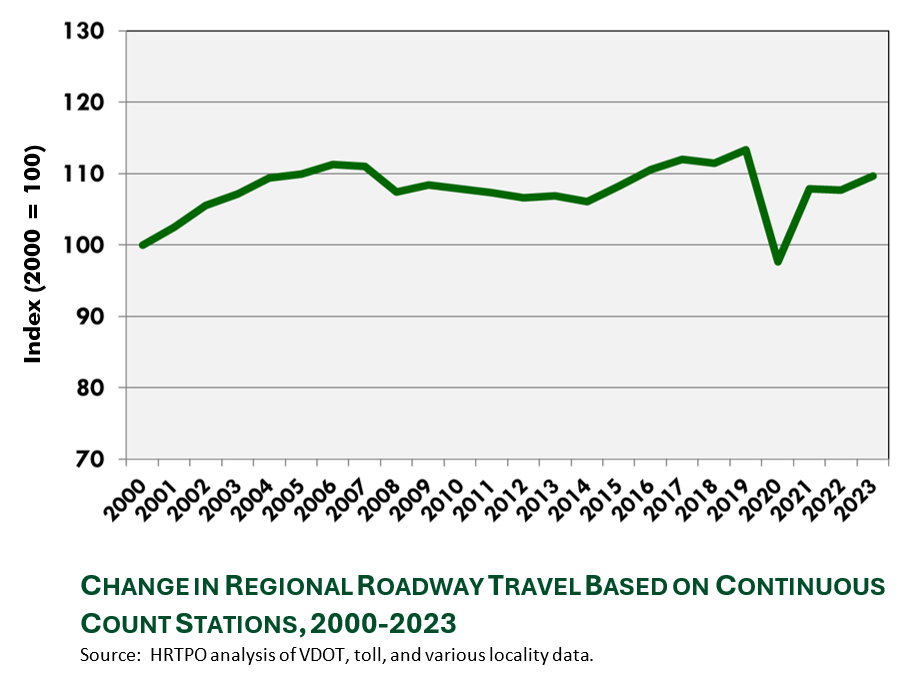
The System Monitoring section details a number of HRTPO annual planning efforts, including the State of Transportation report, Annual Roadway Performance report, and regional performance measures and target setting. The System Monitoring section also includes information on regional roadway travel and trends. HRTPO staff measure the change in regional roadway travel levels by using count stations that continuously collect traffic volume data throughout the entire year. In Hampton Roads, there are approximately 80 locations equipped with continuous count stations, primarily on major roadways. Based on the data collected at these locations, regional traffic volumes grew 1.9% between 2022 and 2023 and 9.7% between 2000 and 2023. However, regional traffic volumes remain nearly 4% below the levels seen prior to the pandemic in 2019.
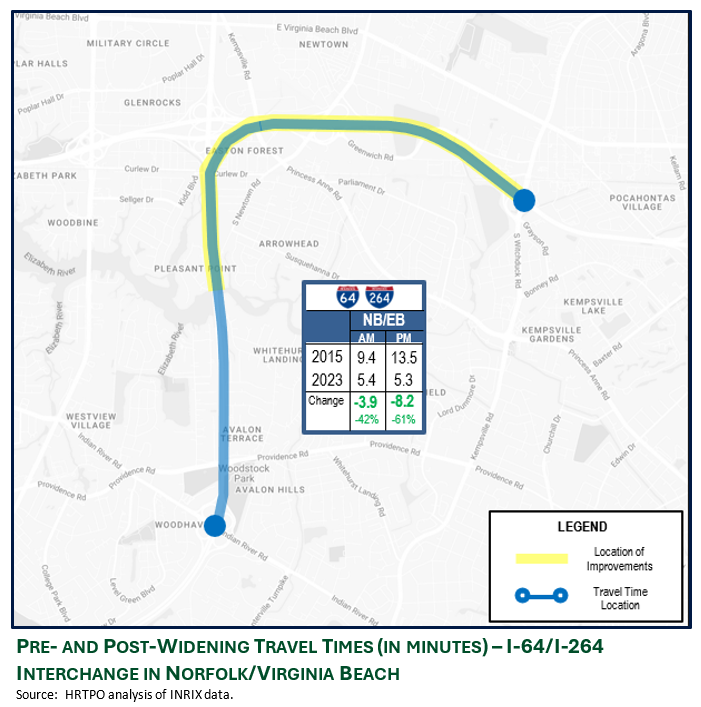
The System Monitoring section also includes information on the benefits of selected projects that have recently been completed. HRTPO staff analyzed the benefits of twelve projects by comparing travel times for the corridor and parallel facilities (where applicable), generally for the year prior to the start of construction and the year 2023, using INRIX travel time and speed data. These projects include roadway widening projects, new roadway projects, intersection improvements, a road diet project, and signal timing improvements. An example showing the I-64/I-264 Interchange is highlighted below.
The System Performance section provides a thorough assessment of the current operating conditions of the Hampton Roads roadway system, including Existing (2023) AM and PM Peak Period congestion levels for the entire regional CMP Roadway Network. The performance of roadway segments throughout the region is analyzed using traffic volume data collected by VDOT, Hampton Roads localities, and toll facilities, and using travel time and speed data collected by INRIX. INRIX collects travel times and speeds on a continuous basis, which allows HRTPO staff to calculate numerous congestion measures, such as average travel speeds, congestion duration, total delay, and travel time reliability.
HRTPO staff also used this analysis to calculate existing congestion levels on a regional basis. Currently, 10% of the travel on the Hampton Roads CMP Roadway Network operates under severely congested conditions during the AM Peak Period, while 14% of the travel operates under severely congested conditions during the PM Peak Period. This compares to 11% during the AM Peak Period and 20% during the PM Peak Period prior to the pandemic in 2019.
HRTPO staff will use the results from Part I of the CMP Study to rank congested locations throughout the region and produce a list of recommended improvements for these corridors. In addition, a survey will be conducted this fall to collect feedback from the public on the congestion they encounter during their travel throughout the region. This CMP update will also provide data for the 2050 Long-Range Transportation Plan (LRTP) Project Prioritization Process.
The Hampton Roads Congestion Management Process 2025 Update: Part I – Introduction, System Monitoring and System Performance Report can be accessed by clicking on the following link:
Part I – Introduction, System Monitoring and System Performance Report